
Remember Christmas? With such a big first quarter of 2026 it feels like such a long time ago but with clients preparing for the tax season, we thought it would be worth going back and looking at how Christmas 2025 performed compared to the previous year. By seeing how cash appeals have changed year-on-year at Christmas time, we can get some sense how our cash appeals at tax are going to perform compared to last year.
Talking with clients and non-clients at the FIA 2026 conference in Melbourne this year we heard conflicting stories - some had enjoyed a good year with increases in responses and income. Others had found the Christmas period tough to navigate and saw lower returns than in previous years. There was also a sense that higher value donors, having a bigger “financial cushion” to soften economic bumps, may have fared better than standard donors.
- Did Christmas 2025 appeals tend to perform better or worse than Christmas 2024 appeals?
- How did higher value donors give compared to the previous appeal, and to what degree was this different than lower value donors?
To compare year-on-year, we combined results from Christmas 2024 and 2025 across 21 clients with a broad range of causes in Australia and New Zealand. All these clients had both DM and EDM activities in market during late October through to December, and the total number of contacts in the analysis was over 100,000. We used linear mixed-effects modelling, which lets us account for the many factors that affect response rate and giving value, and gives us a sense of both the size of any year-on-year change and the statistical evidence behind it. Channel matters — a lot — for response rate, so we recorded whether each donor was contacted via DM, EDM, or both, and built that into the model.
The channel(s) that a donor is contacted on has a substantial effect on response rate and so we recorded whether a donor was contacted via DM, EDM or both so we could count for it as a potential confounder.
Year-on-Year Performance
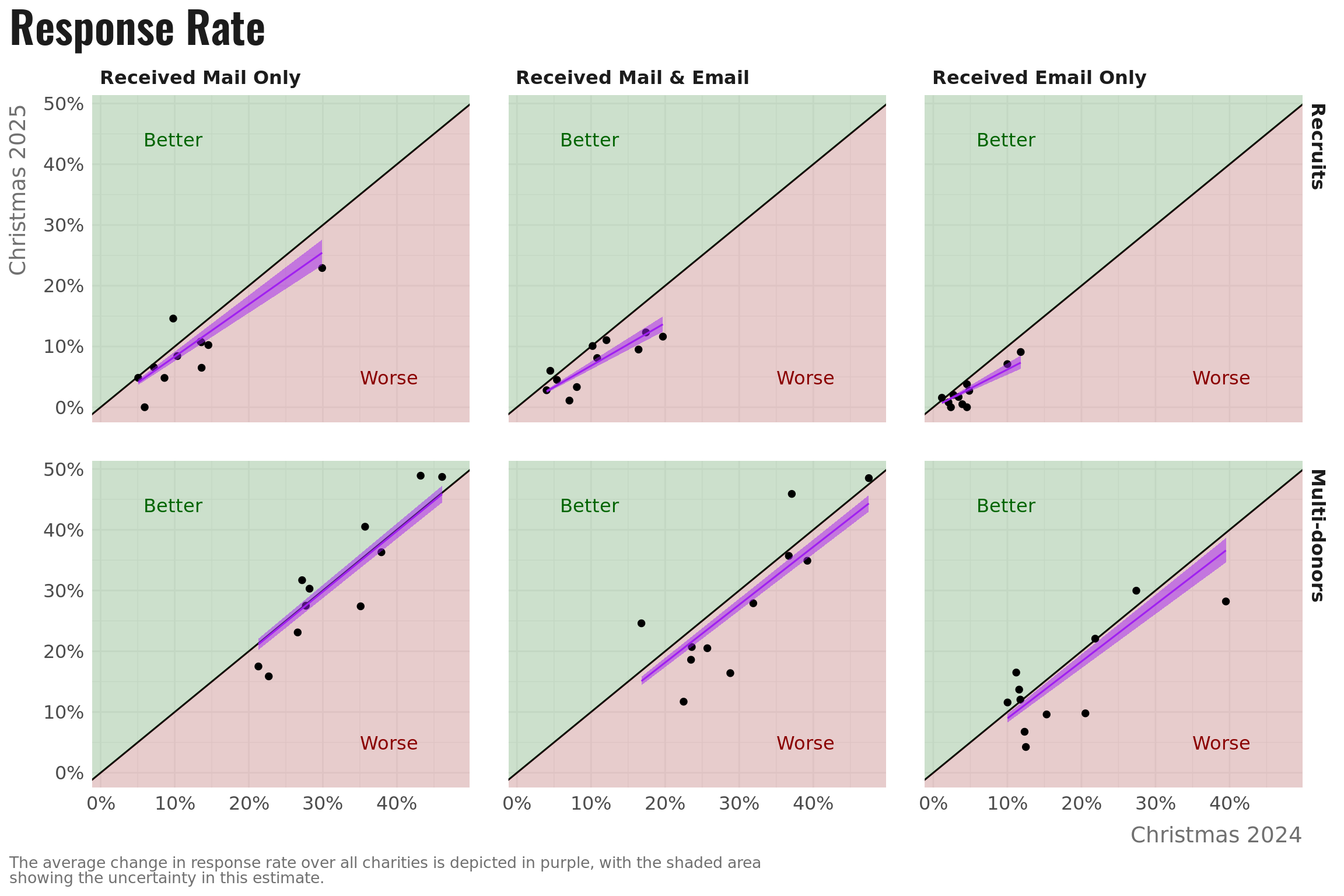
We see a clear reduction in response rate at Christmas 2025 compared to 2024, and this was most pronounced for recruits (donors with a single gift in the last 12 months), where response rates declined by around 1.9 to 3.5% depending on the channel mix. Multi-donors also saw declines in some cases of around 0 to 2.6%. Interestingly, DM-only donors appear to have been partially insulated — their response rates held closer to the previous year with no significant difference overall.
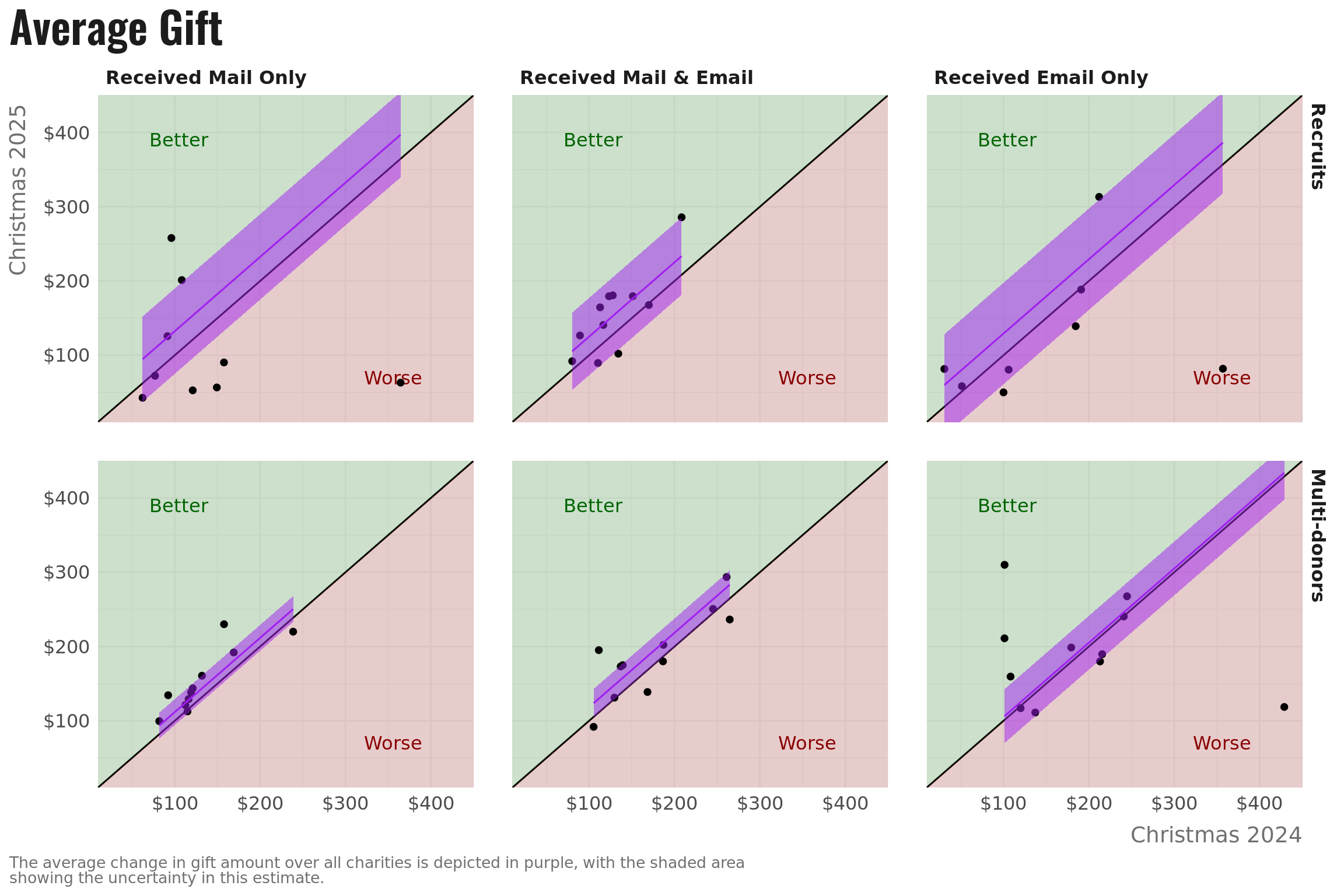
Giving values can be quite changable year-on-year, as they are susceptable to influence from the presence/absense of major donations. Nevertheless, we don’t see any significant deviations on a sector level, despite quite large shifts in average giving value observed for individual charities. The closest to clear significant changes on a sector level were for DM-contacted donors, whose average gift was estimated to have increased by $11.65, and $18.45 if they were also contacted on EDM.
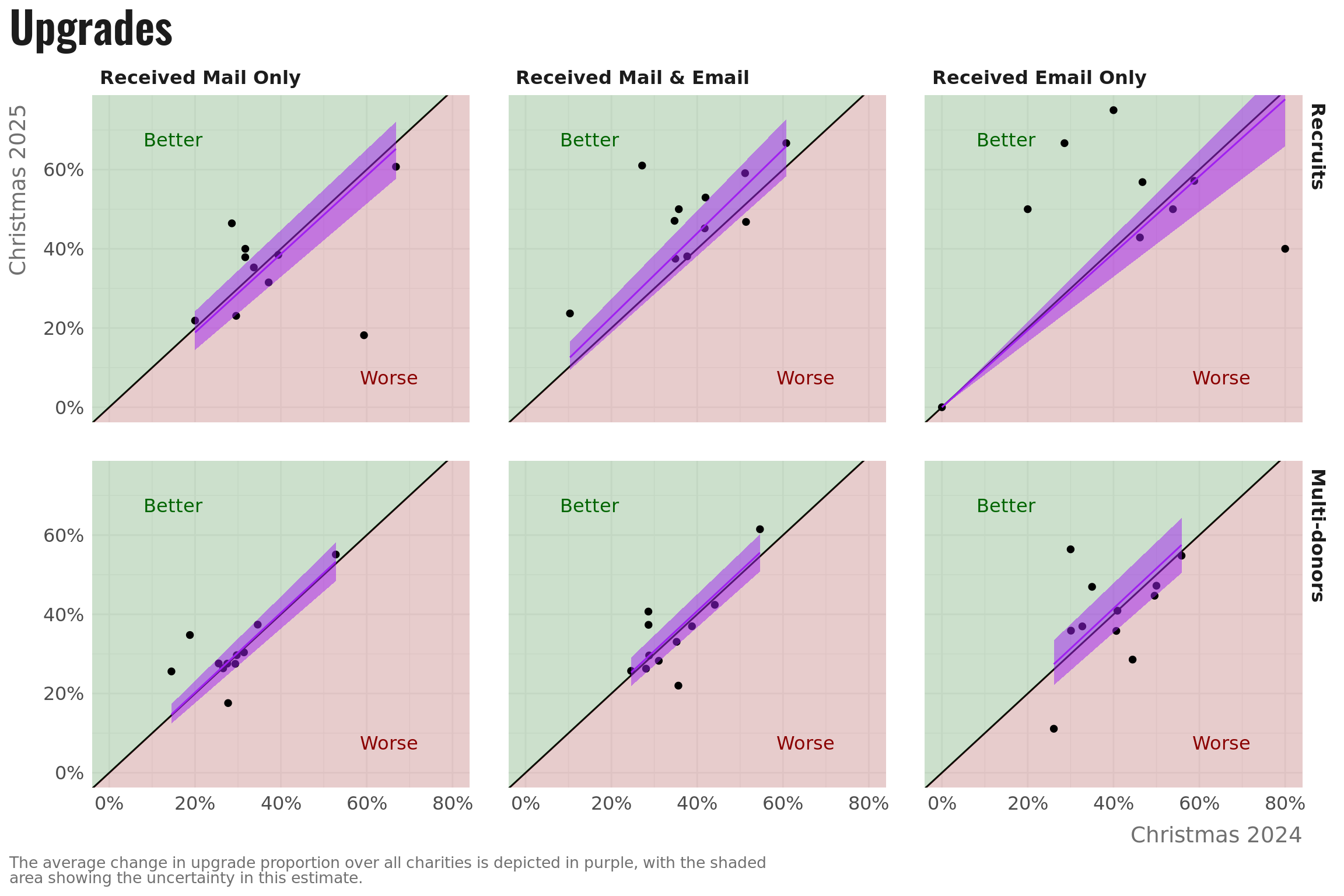
In line with the average giving findings, we saw very little change in the proportion of donors choosing to upgrade on previous giving levels. Again we see a great variety of change year-on-year, potentially as a result of changing ask strategies, but the central estimates are close to 0.
High Value Donor Responses
To explore how high-value donors responded at Christmas, we focused on active donors with at least two prior gifts. These donors make up the bulk of income in a warm appeal, and focusing on this set lets us compare apples to apples to understand how prior giving value affects response rate.
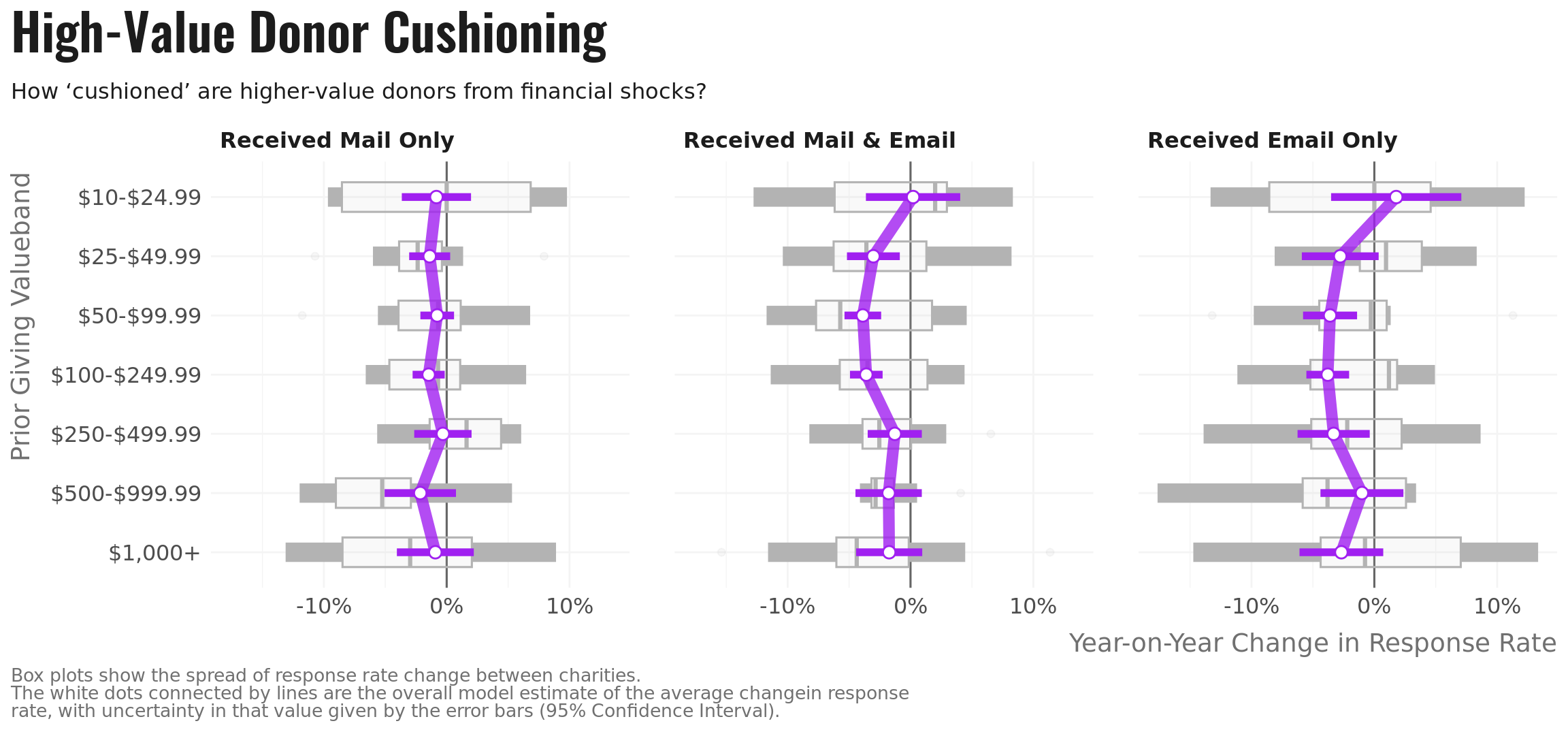
In the plot below, we can see from the box plots that there was a great variety in relative performance year on year between charities, for every value band and channel mix combination.
The purple dots provide the model’s estimate for the response rate change year-on-year for a given value band and channel mix, and we can see that there is a slight dip in performance for donors with value between $25 and $250 the change is more negative than for other valuebands for those who received both Mail and Email, and to a lesser extent for those who received Email. Interestingly, this isn’t see at all in the cohort who only got mail.
Conclusions
So if you had a difficult Christmas this year, what our analysis shows is you’re not alone, and if your Christmas improved on the previous year then you were bucking the overall trend.
We did observe that standard value donors tended to be suppressed to a greater degree than high value donors, but we should keep this effect in perspective as we only saw this for some charities, and not at all in mail-only audiences.
It does look like mail-only audiences fared better overall, with lower overall reduction in response rates, no changes in giving values, and then less exposure of standard value donors to the current financial uncertainty. We should be careful not to misinterpret this finding though. It’s very possible for instance that this audience skews older and more financially secure.